Labels

Aboriginal words (2) Advertising (2) Alexander Ritchie (1) Allan Cunningham (1) Antarctica (4) ANZAC (17) Asylums (10) Banjo Paterson (7) Boongaree (1) Brisbane (2) Brisbane History (2) Bunya pine (1) Cambus Wallace (1) Charles Alfred Owen (1) chickens (1) Chinese shepherds (3) Clement Scott (1) colonial Australia (1) convicts (2) Coronial Files (3) Daphne Mayo (1) Dr. Scholes (2) Dungaree March (1) Dunlop Motor Reliability Trial (5) Endurance (3) Ernest Shackleton (3) Flagstaff Hill Maritime Museum (5) Freestone (1) Ghost Gate (1) Glengallan (1) gold (1) Google Arts and Culture (1) Google Earth (1) Google My Maps (1) Goomburra (2) Great Ocean Road (1) Hector Vasyli (1) Index (3) Jacobs Well Environmental Education Centre (1) Karara (2) Lionel Lindsay (2) Loch Ard ship (15) long read (2) Lunacy (8) Ma Ma Creek (1) Maheno (9) Man from Goondiwindi (1) Matthew Flinders (1) Nototherium (1) Place names (2) Platypus (1) poem for recitation (7) poetry (20) puzzles (2) quarantine (1) Queensland (1) Queensland State Archives (6) Rescue (ship) (1) Rev. William Draper (1) S G Mee (2) Samuel K Cowan (2) Scottish Women's Hospital (1) Shackleton (1) shepherds (1) ship wreck (2) Sloop Norfolk (1) Soldier Letters (6) Southern Downs (1) SS Whampoa (1) State Library of Queensland (1) State Library of Victoria (1) Sydney (1) Sydney Morning Herald (1) The Gap (1) The Sydney Herald (1) Thomas White (1) Toowong Cemetery (1) Transcripts of primary sources (4) Trove (72) Warwick (4) Warwick Cenotaph (1) Warwick Daily News (1) Warwick General Cemetery (1) Waterloo Push (1) William Mitchner (1) Woogaroo (11) Writing (1) Yangan (1) Zachariah Sutcliffe (3)

Thursday, 30 March 2017

What’s in a place name? - Yangan

“Yangan” is a small township on Queensland’s Southern Downs.  The name is normally treated as an Aboriginal place name by various sources, however the word yangan appears in other languages too. Even if we accept that our local town is an Aboriginal place name, the meaning is not clear.

Aboriginal word options - verbs

‘Moving in relation to your present location’

The University of Queensland (2015) site “Queensland Places” suggests that Yangan, previously known as Upper Swan Creek, was so named in 1887 using the Aboriginal word for “going forward or upwards”. The people group for this word is not mentioned. [1]  This is certainly a cheerful name to give a township which has just found itself on a railway line. The SEQ location, Yangan, only appears in Trove after the opening of the railway.  The first mention is in a railway timetable of 1884. [2]


Portion of Railway timetable of 1884.
These are the 'up' trains, 'down' trains not included.

The Department of Natural Resources and Mines notes that Yangan is “reportedly an Aboriginal word, language and dialect not recorded, indicating ‘proceed’ or ‘go away’.” [3] Similarly an article in The Queenslander of 1914, quoting a pamphlet describing the nomenclature of Queensland railway stations says, “Aboriginal for ‘To go on,’ or ‘Go away.’" [4]

This interpretation as “keep going” or “go away” is consistent with a trope in some place names of the White man not understanding either the language, humour or anger of the Aboriginal guide and recording something uncomplimentary as a place name, cf. the surveyor James Warner naming ‘Goodna’ after the Yuggera word for human excrement. [5]

In 1936, a large series of articles on the Nomenclature [naming conventions] of Queensland suggests that A. Meston, a prodigious writer on Aboriginal word meanings, favoured the “keep going”, “go away” option.

YANGAN.— A small township about half-way between Warwick and Killarney. It was originally named Logan's Vale, by Allan Cunningham, after Captain Logan. When the railway line was opened the name was altered to Yangan. The late Mr. Archibald Meston said it was a native word meaning "Let us go on" or "go away." [6]

This is quoted by the Warwick Daily News in 1938 in their nomenclature of the Warwick District. [7]

The Queenslander in the same year offers the following

Yangan, between Warwick and Killarney, is a native name. The late Mr. Meston said it meant "Let us go away", meaning that the blacks bestowed the name on the place when civilisation was beginning to impact severely upon them. [8]

It is a subtle shift in meaning … but it has moved the name from one of defiance to one of Aboriginal hopelessness.

Another verb option can be found in the language of the Bundjalung people … who are known to travel through the area, especially enroute to the Bunya Festival in the Bunya Mountains. Their word root ‘yangani’ can mean “bring to me" or "fetch”, with numerous variations. [9]

Aboriginal word options - nouns

It is risky to see an Aboriginal word in one location and assume it applies in another, which is the reason I am making observations about which people group are noted as using the word.

“Common property”

Despite L. A. Meston offering a different interpretation to that provided by his father A. Meston in one of his own articles (1929) he notes that ‘yangan’ can mean ‘common property’

"Yangan" was the word for "common property" in the Wiradhuri language of New South Wales. A number of words from this extensive language were used in Queensland dialects. [10]


“Dugong”

Interestingly, the most common translation of the word yangan is for the marine creature the dugong. In September 1859 two papers, the Moreton Bay Courier [11] and The (Melbourne) Argus [12], published extracts from a then new book by Edward Wilson, ‘Rambles at the Antipodes’ (available in electronic format at Internet Archive [13]). Edwards offers ‘Yangan’ as a name for the marine creature the dugong.
Lower down on the bay is CIeveland - interesting as being the resort of turtle, and "an animal more interesting even than turtle," "the yangan," or "dugong." The flesh of this animal is not only palatable, but actually curative, when fresh having the taste of tender beef, and when salted nearly resembling bacon. Every dugong yields an oil, which is found, in cases of scrofula and other diseases, to be more efficacious than cod liver oil. [14]

Similarly Dixon et al (2006) in their Australian Aboriginal Words in English [15] note that ‘yangan’ and a number of spelling variants refer to the dugong. They quote from sources to which I would attribute much weight, namely Tom Petrie’s Reminiscences of Early Queensland (1904) and Rev Eippers Statement of the origin, condition and prospects of the German mission to the Aborigines at Moreton Bay, conducted under the auspices of the Presbyterian Church in New South Wales (1841).

This may go some way to explain why Fisherman Island was known as Yangan by the Turrbal people. [16]

Okay … we are not going to see a dugong on the Western side of the Great Divide, but we do know that Aboriginal people from Moreton Bay travelled through the Yangan region on their way to the Bunya Nut Festival.  There would have been Aboriginal language speakers in the locality now known as Yangan at times for whom the word Yangan meant ‘dugong’.  Is it possible we have not understood the ‘humour’ or ‘anger’ of a guide?


“A woman”

Given the sailor stories of dugong being mistaken as mermaids (hence dugong belonging to the Genus Sirenia) the translation of ‘yangan’ as a “wife” or “marriageable woman” by the Gubbi-Gubbi and Butchulla people [17] is also of interest.  Similarly in the Bidjara language of South East Queensland ‘yanga’ is also a word for ‘mother’ [18].


“A specific edible orchid”

There is another fifth option though not the word ‘Yangan’, rather the word ‘N yangan’ (could we have an alternate spelling, or a phonetic spelling?).  This is the earliest use of the word I could find in Trove and it comes from the extracts for a Naturalist’s report in 1850, taken at a location with the Latitude 26 11 12 and Longitude 151 30 00 which when entered into Google Maps gives a location near Proston SEQ.

In the afternoon some blackfellows (sic) approached our camp, bringing in their hands gum leaves of an integral leaved wattle, or Acacia, as tokens of peace. They did not, however, come nearer than one hundred yards or so. I obtained the following words from them by pointing to different parts of my body and by signs … I also obtained their names for the following species of plants which I had then in my hand. - Tharrum, Capparis or Caper trees. N yangan, Cymbidiam (sic). This plant is an Epiphite (sic), and common in the forks of the dead or diseased gum trees. Its blossoms are a rich waxy peach white, very sweet and pendulans succeeded by clusters of fleshy like oblong and octangular seed pods, which are collected and eaten by the Natives. [19]

Variously known as the ‘small groove-leafed cybidium’, the ‘banana orchid’, or the ‘Queensland Black Orchid”, Cybidium canalicatutum is documented as being present in the region [20].  It is also well attested as an Aboriginal food plant. The Cribbs in their ‘Wild food of Australia’ state that …

The pseudobulbs are packed with starch. They can be eaten either raw or cooked but they are mucilaginous and insipid. If the pseudobulb is grated or pounded the starch can be washed out and allowed to settle. … The plant was at one time known as native arrowroot but this term seems to have fallen into disuse. The brown fruit which eventually splits  to release enormous numbers of seeds can also be eaten raw. [21]

Similarly Tim Low in his Bush Medicine notes the use of C. canalicatutum’s milky sap as a healing aid for sores and wounds, and that eating the base stems is a cure for dysentery, with the latter also being used as a cure by early settlers [22].

Non-indigenous word options

Trove offers two other ‘hits’ for the word Yangan prior to 1890 that may be worth noting, if only to disregard them after consideration.

Firstly, a press release on a significant fire in Constantinople which appears in at least 10 papers in the Nov-Dec of 1865, “In less than half-an-hour after the cry of ‘yangan var!’ (there is fire), at least a score of houses were ablaze” [23]. This observation is made more interesting when one considers that the Aboriginal people to the north of Yangan, the Goone-burra or  “fire blacks”, after whom Goomburra is named, were known for their use of fire to modify the landscape.

Secondly, several news article in October 1859 make mention of an execution, by the French, of British and American subjects in New Caledonia that has a focus on a port called Yangan, whereby persons were forbidden to enter the said port on ‘pain of death’ [24].  With the exception of this 1859 article it is very difficult to find any other mention of Yangan in association with New Caledonia.

A conclusion


If the word for the township was chosen by some bureaucrat in the railway department because of some poorly documented understanding of the Aboriginal language we may need to concede the meaning as “going forwards or upwards”, while at the same time acknowledging a somewhat crass cultural appropriation.

If the word was acknowledged as having currency in the region and therefore seemed an appropriate name to the railway bureaucrats then I would favour the orchid derivation, given its presence in the region...  appealing as a joke about dugongs may be.

As for the foreign options I am treating them as examples of the delightful and curious red herrings that a journey through an archive such as Trove throws up.  If I didn’t have more pressing investigations I would be interested in following the New Caledonia link further.


References

[1] University of Queensland (2015) Queensland Places - Yangan. Retrieved March 6, 2017 from http://queenslandplaces.com.au/yangan.
[2] Advertising (1884, May 31). The Telegraph (Brisbane, Qld. : 1872 - 1947), p. 7. Retrieved March 30, 2017, from http://nla.gov.au/nla.news-article174680353
[3] Queensland Government (n.d.) Queensland place names - Yangan. Retrieved March 6, 2017 from https://www.dnrm.qld.gov.au/qld/environment/land/place-names/search#/search=yangan&types=0&place=Yangan38430
[4] QUEENSLAND RAILWAY NOMENCLATURE. (1914, April 25). The Queenslander (Brisbane, Qld. : 1866 - 1939), p. 8. Retrieved March 6, 2017, from http://nla.gov.au/nla.news-article25506057
[5] Queensland Government (n.d.) Queensland place names - Goodna. Retrieved March 6, 2017 from https://www.dnrm.qld.gov.au/qld/environment/land/place-names/search#/search=goodna&types=0&place=Goodna48315
[6] NOMENCLATURE OF QUEENSLAND—318 (1936, October 6). The Courier-Mail (Brisbane, Qld. : 1933 - 1954), p. 12. Retrieved March 6, 2017, from http://nla.gov.au/nla.news-article37005724
[7] ANOTHER LIST (1938, July 26). Warwick Daily News (Qld. : 1919 -1954), p. 6. Retrieved March 6, 2017, from http://nla.gov.au/nla.news-article190396766
[8] What's In A Name? (1938, October 5). The Queenslander (Brisbane, Qld. : 1866 - 1939), p. 8. Retrieved March 6, 2017, from http://nla.gov.au/nla.news-article18907608
[9] http://bundjalung.dalang.com.au/filedown/file/Language-EnglishH-Y.pdf accessed Mar 28, 2017
[10] ABORIGINAL WORDS. (1929, February 21). The Brisbane Courier (Qld. : 1864 - 1933), p. 3. Retrieved March 6, 2017, from http://nla.gov.au/nla.news-article21378490
[11] RAMBLES AT THE ANTIPODES. (1859, September 17). The Moreton Bay Courier (Brisbane, Qld. : 1846 - 1861), p. 2. Retrieved March 6, 2017, from http://nla.gov.au/nla.news-article3720370
[12] RAMBLES AT THE ANTIPODES. (1859, August 26). The Argus (Melbourne, Vic. : 1848 - 1957), p. 6. Retrieved March 6, 2017, from http://nla.gov.au/nla.news-article5686975
[13] Rambles at the antipodes: a series of sketches of Moreton Bay, New Zealand, the Murray River and South Australia and the overland route. With 2 maps; and 12 tinted lithographs, illustrative of Australian life. Accessed March 6, 2017 from https://archive.org/details/bub_gb_tsENAAAAQAAJ
[14] RAMBLES AT THE ANTIPODES. (1859, September 17). The Moreton Bay Courier (Brisbane, Qld. : 1846 - 1861), p. 2. Retrieved March 6, 2017, from http://nla.gov.au/nla.news-article3720370
[15] Dixon, R. M. W., Moore, B., Ramson, W. S. Thomas, M. (2006) Australian Aboriginal Words in English, second edition. (Oxford)
[16] Maroochy Barambah (n.d.) RELATIONSHIP AND COMMUNALITY: AN INDIGENOUS PERSPECTIVE ON KNOWLEDGE AND EXPRESSION. Retrieved March 28, 2017 from, https://ses.library.usyd.edu.au/bitstream/2123/7325/1/Barambah_9781920899714_TEXT.pdf
[17] Bell, J. & Seed, A. (1994) Dictionary of the Gubbi-Gubbi and Butchulla languages. Retrieved March 6, 2017 from https://morayfieldeastss.eq.edu.au/Supportandresources/Formsanddocuments/Documents/Indigenous%20Resources/dictionary-of-the-gubbi-gubbi-and-butchulla-languages.pdf
[18] Yugambeh (n.d.) List of Bidjari Words. Retreived March 30, 2017 from http://www.yugambeh.com/gtcms/structured/strc__resource_482_103___List+of+Bidjara+Words.pdf
[19] JOURNAL OF A NATURALIST. (1850, July 1). The Argus (Melbourne, Vic. : 1848 - 1957), p. 4. Retrieved March 6, 2017, from http://nla.gov.au/nla.news-article4768627
[20] Atlas of Living Australia (n.d.)Cymbidium canaliculatum R.Br. http://bie.ala.org.au/species/http://id.biodiversity.org.au/name/apni/93196#overview accessed March 22, 2017.
[21] Cribbs, A. B. & J. W. (1974) Wild Food of Australia. Fontana.
[22] Low, T. (1990). Bush medicine: a pharmacopoeia of natural remedies. Angus and Robertson.
[23] THE FIRE AT CONSTANTINOPLE, (1865, November 23). The Sydney Morning Herald (NSW : 1842 - 1954), p. 5. Retrieved March 30, 2017, from http://nla.gov.au/nla.news-article13122169 and others.
[24] MISCELLANEOUS NEWS. (1859, October 13). Empire (Sydney, NSW : 1850 - 1875), p. 3. Retrieved March 30, 2017, from http://nla.gov.au/nla.news-article64091350 


Thursday, 23 March 2017

The Man from Goondiwindi Q.

Tourism signage in the rural town of Texas, South East Queensland, asks visitors a knowledge question about Banjo Paterson's poetry.  Following that path not only led me to a Banjo poem, but on an historical journey into Sydney's underworld and a stoush between two of Australia's iconic poets.

From a tourism display in Texas, Queensland.
The poem can be found in the National Library of Australia's newspaper archive, Trove.  I was delighted to see that no one had corrected the text before I got to it.  There is a certain pleasure in correcting the record.


The text of which reads -

The Man from Goondiwindi (Q.)

By the Banjo

I. This is the sunburnt bushman who
Came down from Goondiwindi (Q.).

II. This is the Push from Waterloo
That spotted the sunburnt bushman who
came down, from Goondiwindi (Q.).

III. These are the wealthy uncles — two,
Part of the Push from Waterloo
That spotted the sunburnt bushman who
Came down from Goondiwindi (Q.).

IV. This is the game, by no means new,
Played by the wealthy uncles — two,
Part of the Push from Waterloo
That spotted the sunburnt bushman who
Came down from Goondiwindi (Q.).

V. This is the trooper dressed in blue
Who busted the game by no means new
Played by the wealthy uncles— two,
Part of the Push from Waterloo
That spotted the sunburnt bushman who
Came down from Goondiwindi (Q.).

VI. This is the magistrate who knew,
Not only the trooper dressed in blue,
But also the game by no means new,
And likewise the wealthy uncles— two,
And ditto the Push from Waterloo
That spotted the sunburnt bushman who
Came down from Goondiwindi (Q.).

VII. This is the tale that is oft gone through
On Western plains where the skies are blue.
Till the native bear and the kangaroo
Have heard of the magistrate who knew
Not only the trooper dressed in blue,
But also the game by no means new,
And likewise the wealthy uncles— two,
And ditto the Push from Waterloo
That spotted the sunburnt bushman who
Came down from Goondiwindi (Q,).

Evening News (Sydney, NSW : 1869 - 1931), Saturday 17 December 1904, page 12

Some observations

The poet's design strategy is clear -  eight syllable lines with rhyming endings throughout (including a clever use of the stand alone letter Q for Queensland).  Stanzas become one line longer with increasing stanza number with the exception of stanza seven which has gained three lines.  This growth of verse is known as cumulative verse.  Readers may recognise the similarity with 'The 12 Days of Christmas' or 'The Old Woman who Swallowed a Fly.'  Paterson also used it in 'The Dam that Keele Built.'

The use of illustration is important.  The poem is presented in some anthologies as a text only poem, but this illustrated version seems to suggest that the words and the accompanying art are both needed to understand the work.  This page of the paper appears to be a collaborative piece between poet and artist.

The Waterloo Push was a notorious gang of disaffected youths.  There were a number of gangs, called 'Pushes' in Sydney at the time that Paterson wrote, with names such as the Miller Point Push, the Waterloo Push and the Rocks Push (eventually "The Push").  The Waterloo Push's notoriety was exemplified in the gang rape of a young woman in 1886, a crime labelled the Mt Rennie Outrage, which saw a number of people go to the gallows.  But the newspapers continued to report bashings and violence from this gang after the Mt Rennie Outrage.

Given the link between the image and poem, I wonder if the 'uncles' are specific people that the reading public would have been able to identify.


It is useful to compare this work with other works by the Australian Poet, Henry Lawson, namely "The Captain of the Push" and the related "The Bastard from the Bush".  Granted there is debate about whether 'the bastard' really was authored by Lawson - it was certainly too bawdy for him to place his name on it. A distinct battle of ideologies between Paterson and Lawson played out in the magazine 'The Bulletin', and was therefore known as the "Bulletin Debate".  Have another look at the two uncles then Google an image of Henry Lawson and see if he would fit a composite of these two characters (or perhaps I am seeing too much!).  Paterson saw the bushman as a better human then the city man, and Lawson had an opposite view.  While this poem is not published in 'The Bulletin' it does seem to be engaging the topic of the debate.  The bushman comes to the rough part of the city, has an interaction with the criminal part of town, but is then able to hold his own in court and return to his bush home unscathed and gentlemanly.

If I could continue the journey that this little ramble started, I think there is much to be gained from a further analysis of the argument between these two Australian voices.


Tuesday, 28 June 2016

Sheep killed by lightning - 1857


While researching the history of the Goomburra Valley I encountered this story that captured my interest, about a storm which passed through on 19th November 1857.  Clearly a story that also captured the interest of a number of newspapers at the time, as this press release appeared in no less than nine papers, with The North Australian [1] being the first to publish on 1 December ... the quote below is from this edition.
DESTRUCTION OF SHEEP BY LIGHTNING—During a violent thunderstorm which visited the Goomburra station, Darling Downs, on the night of the 19th ultimo, 300 sheep were killed by the electric fluid. It appears that at the head-station the lightning was extremely vivid and dangerous and that in one yard 270 sheep were struck dead by an electric stroke, while at another yard about seven miles distant, 30 more were destroyed at the same time by the same destructive agency. The flocks in great terror were huddled together, and it required the greatest exertions of the watchmen and shepherds, who were summoned to their assistance, to prevent a large portion of the flocks from being smothered. At the time the accident occurred at the head-station, the man in charge of the flock, much to his credit, was standing by the flock keeping vigilant watch, and discerned the effect of the lightning in sufficient time to give the alarm ; and it is owing to this circumstance that the loss was not greater. Mr. Patrick Leslie, the newly elected member for the United Pastoral Districts, is the proprietor of the station where the disaster occurred.
Next to publish was the Sydney Morning Herald [2] on the 7th December.  Then deriving from the publication in the Herald the following papers, The Argus [3] on the 12th December, The Ballarat Star [4] on 14th December, The Goulburn Herald and County of Argyle Advertiser [5] (which references The North Australian ) on 16th December, Portland Guardian and Normanby General Advertiser [6] on 18th December, also on the 18th December The Bendigo Advertiser [7].  Followed by the The Armidale Express and New England General Advertiser [8] on 19th December. Finally the Ovens and Murray Advertiser devotes some space to the report in its Christmas Day edition (also quoting the North Australian). And so the 'news' cycle stops more than one month after the event took place.

While the story itself is interesting it is not unique. Use the phrase "sheep killed by lightning" in the Trove search tool and over 500 results appear. This set of articles about a specific event in Goomburra is also interesting as a reflection on the speed of media today.  In 1857 both reports and the papers themselves would have been mostly delivered by horseback, today 'news' of such age would probably be deemed too old to publish.


References

[1] LOCAL AND DOMESTIC. (1857, December 1).The North Australian, Ipswich and General Advertiser (Ipswich, Qld. : 1856 - 1862), , p. 4. Retrieved June 29, 2016, from http://nla.gov.au/nla.news-article78850984

[2] MORETON BAY. (1857, December 7). The Sydney Morning Herald (NSW : 1842 - 1954), , p. 8. Retrieved June 29, 2016, from http://nla.gov.au/nla.news-article13003657

[3] NEW SOUTH WALES. (1857, December 12). The Argus (Melbourne, Vic. : 1848 - 1957), , p. 5. Retrieved June 29, 2016, from http://nla.gov.au/nla.news-article7143285

[4] Local and General news. (1857, December 14). The Star (Ballarat, Vic. : 1855 - 1864), , p. 3. Retrieved June 29, 2016, from http://nla.gov.au/nla.news-article66045626

[5] FORGED £10 NOTES. (1857, December 16). The Goulburn Herald and County of Argyle Advertiser (NSW : 1848 - 1859), , p. 2. Retrieved June 29, 2016, from http://nla.gov.au/nla.news-article118248536

[6] NEW SOUTH WALES. (1857, December 18). Portland Guardian and Normanby General Advertiser (Vic. : 1842 - 1876), , p. 2 (EVENING.). Retrieved June 29, 2016, from http://nla.gov.au/nla.news-article64570054

[7] INDIA. (1857, December 18). Bendigo Advertiser (Vic. : 1855 - 1918), , p. 3. Retrieved June 29, 2016, from http://nla.gov.au/nla.news-article87977577 

[8] New South Wales Intelligence. (1857, December 19). The Armidale Express and New England General Advertiser (NSW : 1856 - 1861; 1863 - 1889; 1891 - 1954), , p. 3. Retrieved June 29, 2016, from http://nla.gov.au/nla.news-article189959432

[9] LOCAL COURT. (1857, December 25). Ovens and Murray Advertiser (Beechworth, Vic. : 1855 - 1918), , p. 2. Retrieved June 29, 2016, from http://nla.gov.au/nla.news-article113235931


Friday, 15 April 2016

Gallipoli - The scale of our war

A recent trip to New Zealand gave rise to the privilege of a visit to the Te Papa museum in Wellington. Te Papa's vision is to be a forum for New Zealand "to present, explore, and preserve the heritage of its cultures and knowledge of the natural environment". It is a brief well met.

Currently Te Papa has an exhibition entitled "Gallipoli: The scale of our war" that is a moving and sombre commemoration of New Zealand's involvement in WWI.  With ANZAC Day approaching it seemed appropriate to reflect on the amazing storytelling that has taken place in this exhibit.

Te Papa teamed up with a number of Wellington companies to produce the exhibition, of particular note Weta Workshops, known for their work in the movie industry with projects such as Lord of the Rings, Avatar, Mad Max Fury Road and many others (our visit to Wellington also included a visit to Weta :-)).

Weta are known for their amazing special effects skills, which has included the development of software ('massive') to simulate large crowds; think of the battle scenes in Lord of the Rings - Return of the King. While a topic like "the scale of our war" may prompt the museum audience to expect a crowd simulation, and certainly the immensity of loss endured may invite the use of such simulation, the team rightly created a very personal journey which needed no crowd simulation to impart the scale of the war experience.  Instead the visitor is taken on a journey through the war punctuated by the lives of eight individuals.  These eight are chosen as representatives of the nearly 3,000 people who left New Zealand's shores to participate in WWI (93% of whom were killed).

The 'eight' are people whose lives have been well researched and for whom a 2.4x life size mannequin has been created.  The mannequins are both imposing and deeply intimate, placed in rooms that are small enough that the visitor is compelled to be close enough to observe detail down to the level of individual hairs on the bodies.  The mannequins alone represent 24,000 hours work.

But these 'eight' are also placed within a specific, somewhat labyrinthian, timeline that the visitor walks along guided via a red line on the floor. Crosses at each date in the time line symbolise the number of New Zealanders who died on that date. It is very confronting.  So confronting in fact that I needed to visit the exhibit twice, having bailed out on the first attempt from being overwhelmed and then coming back the next day.

Map of the display, showing its labyrinthian construction.
Floor decoration showing the use of crosses to acknowledge the New Zealanders killed.
A cut away uniform with cut away packs, which on closer inspection reveal the contents. In the midst of a display about war this seemed a fitting tribute to the 'unknown soldier' a young man who had become a ghost.
Lieutenant Spencer Westmacott, the first of the 2.4x mannequins
Lieutenant Colonel Percival Fenwick, 2.4x mannequin.
Three gunners, part of the Maori contingent, 2.4x mannequins.
One of the mannequin arms showing the attention to detail, each hair was added individually.
Private Jack Dunn, a man condemned to execution for falling asleep at his post.  Penalty commuted due to extenuating circumstances - pneumonia 2.4x mannequin with 2.4x flies.
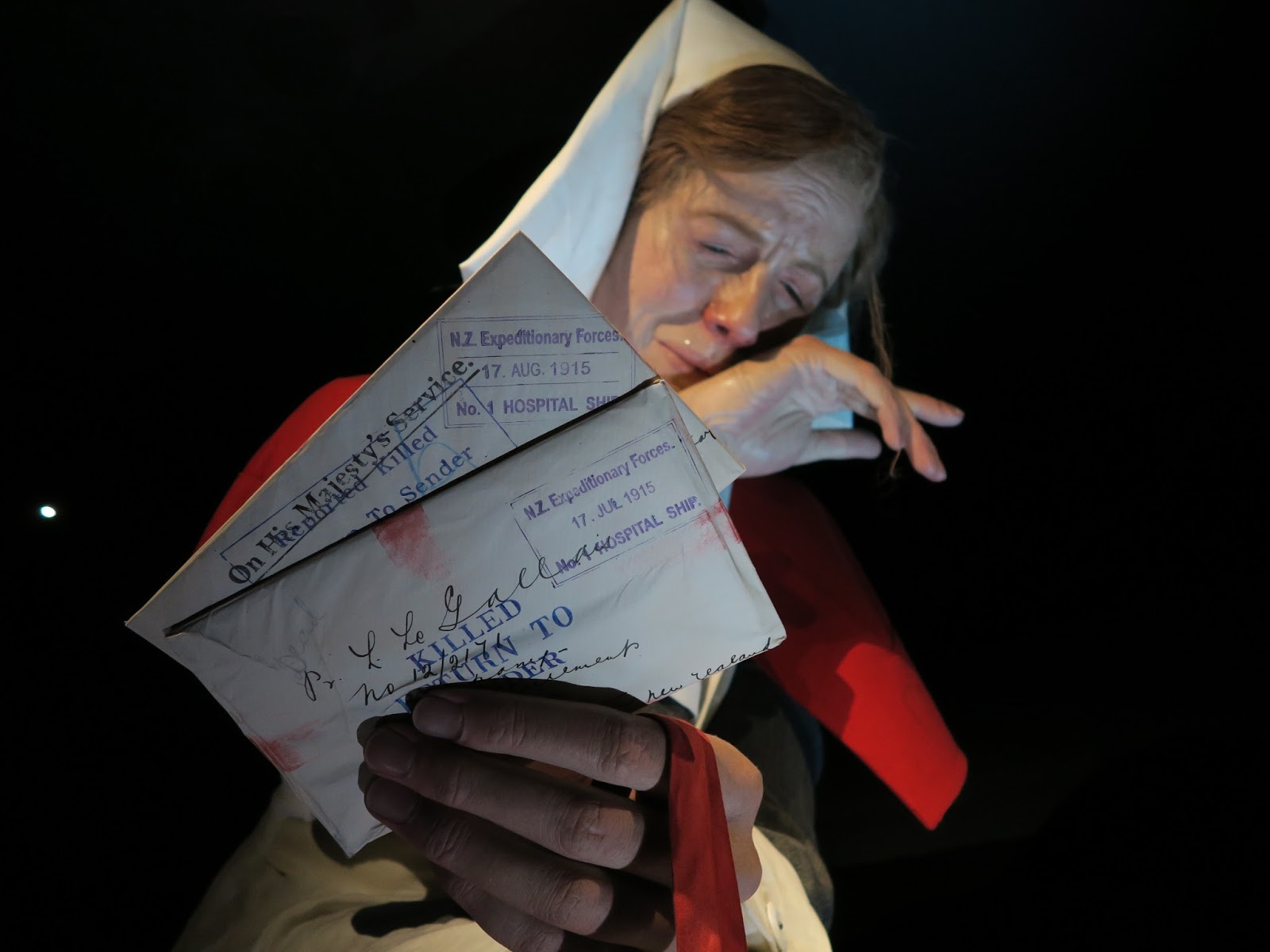
Charlotte Le Gallais, Staff Nurse aboard the hospital ship the 'Maheno'. 2.4x mannequin with 2.4x letters. For Queensland readers the name 'Maheno' may ring a bell.  It is a shipwreck on the eastern shore of Fraser Island, having been run aground by a cyclone in 1935.

Another depiction of 'Lottie' this time as a miniature onboard a cutaway version of the Maheno.  This repetition of themes was a clear indicator of the care that had been taken in constructing the display narrative that went through this exhibition. 
Sergeant Cecil Malthus wades through a sea of remembrance poppies, part of the interactivity of the display.
Visitors were invited to write on a poppy and leave a message with the soldier. 
An opportunity to cleanse oneself at the end of the exhibition.  A profound and touching finale to a profound and touching exhibition.


This is a very well constructed exhibition, worth seeing for the skill with which it tells the story it is seeking to tell and the workmanship in the models. Entry to the museum is free, and from what I can tell the exhibition while listed as temporary will run until 2018.

Below are two links with more information.

Wednesday, 20 January 2016

Hyde Park Barracks

This post is a report of a recent brief visit to the Hyde Park Barracks Museum.

I have chosen to blog about this particular venue as I was very impressed with the way in which the building and its collection had been curated. It found a great balance between engagement with the collection; concise and informative narrative, and some innovative and elegant displays.

The facility provides good free printed guides for adults and an interactive workbook for children.

As well as single entry tickets this facility can be included in a pass which covers this venue and three other museums:

  • Museum of Sydney
  • Justice and Police Museum
  • Susannah Place Museum

The building has had a varied history, which can be divided into four phases:

  • 1817 - 1848 Convict Period (50,000 convicts)
  • 1848 - 1886 Immigration and Asylum Period (40,000 women and children)
  • 1887 - 1979 Courts and Offices Period
  • 1979 - today Museum Period

The main focus of the museum is on the first two periods of time.

The facility was listed on the UNESCO World Heritage Register in 2010, along with ten other Australian Sites which document the convict history of Australia.

For people interested in the history of Australia this site is well worth the time and small cost associated with a visit.

External view of the Barracks.  The building was designed by a convict architect, Francis Greenway, who received a full pardon for his work.
Rats which at other museums in Sydney are used as an icon for the arrival of the plague in Sydney in 1900 AD are here lauded as the archaeologist's friend as many of the items in the collection were preserved in the dry environment of rat nests. 'Ratty' is the mascot for the kids' interpretative guide.
Rats were not kind to all of the artefacts placed in their care.
Clever use of visual prompts allows the visitor to intuit the one time presence of a staircase.
Convict Period - On the third floor a row of hammocks allows visitors to experience a bit of life in the barracks, albeit with a lot less noise and smell than the original inhabitants needed to endure.
Convict Period - Cut out figures act as story boards for selected persons from the 50,000 convicts who passed through the facility.
Convict Period - a display label - a good example of a concise narrative that easily allows the visitor to imagine the story.
Immigration Period - The use of cut out cards gives a sense of layers
Immigration Period - Elegant boxes with multiple glass layers allow for the display of multiple artifacts on different layers.  On some of the boxes the opening of the lid would activate a switch with triggered an audio or a video element.
Immigration Period - screen printed panels allow for one of the 40,000 stories to be told.
Immigration Period - A more encompassing view of the boxes and bed used in the immigration display.

Wednesday, 13 January 2016

The Warwick Gold Hoax - 1852

Investigation into the history of gold in the Warwick region on 'Trove' uncovered a curious incident in which a local 'artist', a Mr Edward Thomson hoaxed a Mr Edward Hammond Hargraves. Hargraves is the man credited with discovering the first payable gold field in Bathurst [1], the discovery that started the gold rush to that part of Australia.  It is a juicy little story and I should not have been surprised that Maurice French had written of it [2].  

According to numerous sources Hargraves and money had trouble staying together; he had a number of failed ventures in colonial Australia, visited the gold fields in California where he upskilled in the latest gold prospecting techniques and then returned to Australia.  The Australian dictionary of Biography notes ...
He returned to Sydney in January 1851, planning to win a fortune not so much by finding gold but by claiming the government reward for discovery of a payable goldfield. 
...
Although Hargraves exaggerated and falsified his finds he never denied his main purpose. The government gave him £10,000 and from 1877 an annual pension of £250. [3]
SBS notes
The audacity of Hargraves knew no bounds. He claims in his autobiography "it was never my intention ... to work for gold, my only desire was to make the discovery, and rely on the Government and the country for my reward". [4]
French describes Hargraves as a 'charlatan', 
Intrinsically lazy and an inveterate dreamer, Hargraves was more a skilled self publicist than a prospector. [2]
He had certainly cheated his partners in the Bathurst venture.  As French tells the story, this little episode from the papers is a test by Warwick locals into the credentials of the person of Edward Hargraves.

Mr Hargraves wrote to the colonial secretary of the day informing him thus [4] ..
... I have received a note from Mr. Patrick Leslie enquiring whether it was likely that a gold field would be found in the northern districts, I have replied in the negative, so far as my researches have gone. The Canning Downs gold excitement was got up with a leaden bullet covered up, or rather over, with gold leaf, previously beaten out into a nugget, like looking specimen. The perpetrator of this hoax, a Mr. Thompson, an artist, told me so himself, in presence of other gentlemen.
In conclusion, I regret that my labours in these districts should have been of so little avail; but if the inhabitants cannot boast of a gold field, they can assert without fear of contradiction, that they are in possession of the finest part of New South Wales ; indeed, it is the best country I have ever seen.
I have the honour to be, Sir,
Your most obedient servant, 
E.H. HARGRAVES.
Thanks for the compliment about the fineness of our district!  Hargraves' 'name-and-shame' strategy brought a robust response from Mr Thompson who took out letters in both the Sydney Morning Herald [6] and The Maitland Mercury and Hunter River General Advertiser [7].  The text of which follows.
ORIGINAL CORRESPONDENCE.TO E. H. HARGRAVES. ESQ. 
Per favour of the Sydney Morning Herald.
Sir,
I observed in the fifth article of your official report on the northern districts, an assertion, which I beg leave, with all due deference to you, most flatly to contradict. You state that the "Canning Downs" gold excitement was got up by means of a leaden bullet, covered with gold leaf, having previously been beaten into a nugget-like shape - that the perpetrator of this hoax (a Mr. Thomson, an artist) told you so himself, in the presence of other gentlemen. That I was the perpetrator of this hoax (if hoax it could be called), I don't deny ; but you must be labouring under some mistake in supposing that I told you the bullet was the cause of the Canning Downs gold excitement. I was not aware of having made such a statement to you, or to any one else. On the contrary, when you were at Warwick I told you that I had found gold in small quantities, at Lord John's Swamp, the Severn, and in gullies leading into M'Intyre's Brook ; and that I had every reason to believe it would be found to pay if properly worked. The fact of gold having been found at Lord John's Swamp may be proved by the testimony of Messrs. Patrick Leslie, W. Leith Hay, E. Moriarty, surveyor, and many others, who were present when I washed out gold from the soil at Lord John's Swamp. Messrs. Samuel Burgoyne and R. Wright were present when got at the Severn, and Messrs. Burgoyne and M'Lachlan when got in a gully leading into M'Intyre's Brook.
To return to the great northern leaden bullet hoax. It was perpetrated long after I had given up digging at Lord John's Swamp, where I had swamped more time and money than I could well afford (artists in this colony are not proverbial for being overburdened with heavy purses) ; so that the bullet could not have been the cause of the Canning Downs gold excitement, as you are pleased to term it. I, more willingly than I otherwise would have done, gave up (for the time) the search for gold, having heard that the great Hargraves was about to visit the district. But, alas! when he came what did he do? He jogged quietly along the road on the old chesnut, and saw some black mud rocks, and porphyritic schist. (What are these?) When at Warwick, not-withstanding the entreaties of many that he would visit M'Intyre's Brook, the great Hargraves could not be prevailed upon to exchange the comforts of Darling Downs for a camp, with beef and damper, at the Brook.
You have been blamed, and I think not unjustly, for not making an attempt in this neighbourhood ; but, with the tools you had, I was at a loss to know how you could give any place a fair trial. When I saw them previous to their sale by auction at Ipswich, they appeared to be most inadequate, at the same time flimsy articles. The pick did not seem to have much to do for some considerable time, being thick with rust down to the very point (but the black mud rock might have caused that). The prospecting pan bore most suspicious traces of beef or some other viands.
Some ill-natured people have asserted that I was supplied with gold dust by Mr. George Leslie, and that when visitors came to the Canning Downs diggings, I what they call "peppered" the hole, and then washed out the provided gold dust in their presence, so as to inveigle them into the belief that it was there in quantity, Now, on behalf of Mr. George Leslie, as well as for my own credit, I declare this to be a gross and malicious falsehood. Some of said charitable individuals are of opinion that I was a paid agent of the squatters of these districts, to deceive and humbug the multitude by the above means. This, also, I now beg leave publicly to contradict. My digging exertions at Lord John's Swamp, and elsewhere, were as much for my own amusement as any thing else. Digging is good for the health, and, judging from appearances, seems to have agreed with you in an eminent degree, seeing that your condition is certainly improved within the last year or two.
In conclusion, I beg to inform you that I intend to try the digging in this district again, and heartily hope may be successful, if it is only to prove that the great E. H. Hargraves knows just about as much of geology as I do, and that is precious little. At the same time I regret that E. H. Hargraves would not find something better and more satisfactory for his official reports concerning the auriferous qualities of the northern districts than the trivial piece of tomfoolery he has deemed fit to make mention of.
I beg to remain, Sir, &c, 
EDWARD THOMSON   
An Artist. Warwick, Darling Downs, August 9.
There is a larrikin feel to the artist's response and it is one of the things that amazes me about old newspapers - the way in which persons can be so freely maligned in the press.
As history will prove there was gold to be found in the region but it was not enough to become the region's focus.

References


[1] State Library of NSW (Edward Hammond Hardgraves Retrieved Jan 13, 2016 from http://www.sl.nsw.gov.au/discover_collections/history_nation/gold/rumours/hargraves.html


[2] Maurice French (1989) 'A leaden bullet covered with gold leaf': Gold discoveries on the Darling Downs before separation.

https://espace.library.uq.edu.au/view/UQ:205779/s00855804_1989_13_11_417.pdf

[3] Bruce Mitchell, 'Hargraves, Edward Hammond (1816–1891)', Australian Dictionary of Biography, National Centre of Biography, Australian National University, http://adb.anu.edu.au/biography/hargraves-edward-hammond-3719/text5837, published first in hardcopy 1972, accessed online 13 January 2016.


[4] SBS http://www.sbs.com.au/gold/story.php?storyid=32


[5] LATEST NEWS. (1852, July 28). The Moreton Bay Courier(Brisbane, Qld. : 1846 - 1861), p. 1 Supplement: Supplement to the "Moreton Bay Courier". Retrieved January 13, 2016, from http://nla.gov.au/nla.news-article3713062

[6] ORIGINAL CORRESPONDENCE. TO E. H. HARGRAVES. ESQ. (1852, September 11). The Sydney Morning Herald (NSW : 1842 - 1954), p. 3. Retrieved January 13, 2016, from http://nla.gov.au/nla.news-article12939920


[7] Original Correspondence. (1852, September 15). The Maitland Mercury and Hunter River General Advertiser (NSW : 1843 - 1893), p. 4. Retrieved January 13, 2016, from http://nla.gov.au/nla.news-article663503

Saturday, 25 July 2015

The Dungaree March - 1915

The reframe during the commemoration of military events is 'Lest we forget'.  As I reflect on my own interest in history I wonder if the reframe might be better stated 'Lest we forget any more than we already have'.  The Dungaree March features large in the Warwick narrative but access to simple lists of participants, with the exception of the 28 initial participants, is not that easily accessed. McCaughley's limited ditribution work is an exception, but it, like this post, is not complete.  This post is provided in the hope that people interested in seeing which families participated in the March may have easy access to such a list.

Admidst all the other 100th Aniversary commemorations this year is the 100th anniversary of the Dungaree March, one of nine 'snowball marches' in which newly enlisted soldiers marched through regional areas in the hope that they would accrue more recruits to go to the battle fields of WWI as they marched [1, 2].  The Dungaree March traversed 270 kilometres from Warwick to Brisbane via Toowoomba.  The journey was conducted over 15 days, 16–30 November 1915, with the following itinerary.

Day 1. Warwick to Allora
Day 2. Allora to Clifton
Day 3. Clifton to Greenmount
Day 4. Greenmount to Cambooya
Day 5. Cambooya to Toowoomba
Day 6. Toowoomba
Day 7. Toowoombato Helidon
Day 8. Helidon to Gatton
Day 9. Gatton to Laidley
Day 10. Laidley to Rosewood
Day 11. Rosewood to Ipswich
Day 12. Ipswich
Day 13. Ipswich
Day 14. Ipswich to Oxley
Day 15. Oxley to Brisbane

The 'Dungarees' were named after the item of clothing that the soldiers were issued with – the dungaree jacket – which from what I can tell is the jacket with four large front pockets in which soldier portraits are often taken.  'Dungaree' in common speech today refers to bib and brace overalls, but this was not the meaning during the recruitment drive.

Re-enactments

In 1998 a reenactment march lasting 12 days followed by 2 days of involvement with ANZAC Day ceremonies was conducted.  This march placed a number of monuments enroute and resulted in the publication of McCaughley's book [1].

In 2015 the Military Brotherhood Military Motorcyle Club (MBMMC) has planned a reenactment ride for the last week in November 2015 (ride details).  They will be accompanied by The Road Riders for Jesus (ride details).

Monuments and memorials

The march was at one time commemorated at the Warwick end by a fountain in the Condamine River near the O. O. Madson Bridge until a series of floods damaged it sufficiently that it was decommissioned around 2010.

Dungaree Fountain, Condamine River, Warwick.  Photo Simon Hamlet, January 2007.

28 trees were planted opposite the War Graves section of the Warwick Cemetery.  With a plaque to signify the event this was part of the 1998 reenactment march.


There is also a plaque at the Warwick Cenotaph with the names of the 28 enlistees who first left Warwick.

Monument Australia also lists the following other 'Dungaree March' monuments (links take you to the appropriate site).
A plaque of the Victoria Street Bridge abutment, Brisbane was also installed during the re-enactment. Access to the abutment was improved with a pedestrian overpass by the Brisbane City Council in 2015.
The Dungaree plaque on the Victoria Street Bridge Abutment, looking East to the Brisbane CBD.  Photo Simon Hamlet September 2015.

List of Participants

McCaughley notes that:
Out of the 125 men who marched into Albert Square on 30th November 1915, only 103 have been traced with 34 having only scant records, and 22 being untraceable at this time. [page. 11]
All of the Dungarees are now dead with the last Dungaree, Erik Kingsley Abraham of Boonah, dying in 2003.  He was awarded a state funeral.

The list below is based on McCaughley's [1] list, with enlisted persons listed alphabeticaly by surname within the locality where they enlisted.  NR denotes 'no records' as per McCaughley's list of 103, KIA denotes 'killed in action' or killed as a result of injures obtained while in action (10 people have KIA beside their name). The Brisbane Courier of 27 November 1915 [3], provides a list of 43 recruits which agree with that in McCaughley.

The commanding Officer Lieut. David Johnston Binnie is not included in the list as it is probably incorrect to consider him a recruit.

McCaughley [1] notes the enlistment of 11 un-named persons. These appear under enlisted at Helidon and Gatton.

Most sources consider that the 28 people left Warwick, but I have included 32 enlistees for Warwick as four people enlisted at Warwick but joined the march at a later time.

The Brisbane Courier of 21 November 1915 [4] states ...
When the Southern Downs recruits left here for the march to Brisbane some of the boys who had arranged to join them were unable to be ready in time. The following recruits from this district will join between Toowoomba and Brisbane: Messrs. A. Courtney, C. Goodwin, P. Brosnan. P. J. Fitzgerald, W. Higgins, J. McIntosh, W. E. Girtler, H. Garvey, C. Harris and P Bartnett. It is under stood that Girtler, McIntosh, Garvey, and   Bartnett will join the march at Ipswich.
Brosnan, Harris and Bartnett were not in McCaugley's list, perhaps they are some of the unnamed recruits who joined the march at either Helidon or Gatton.

According to the Australian War Memorial records

  • a Patrick Brosnan from Killarney did join on the 15 Novemeber 1915 [5]. He is probably one of the Dungarees,
  • there are no records for any Bartnett in WWI.
  • there a numerous C. Harris's on the record for WWI and this may be an investigation worth following further.


Enlisted in Warwick (32)
  • Anderson, Percy
  • Anstey, Henry
  • Atkins, Lyall Henry
  • Baillie, Richard Patrick
  • Barnett, David
  • Bell, Alexander John
  • Bonnet, H. H. - NR
  • Burns, Thomas Frederick - NR
  • Clarke, S. J. - NR
  • Corby, Samuel James
  • Courtney, Allan Douglas
  • Darragh, Archibald
  • Day, C. W. - NR
  • Edmonds, Thomas Christmas
  • Evans, Clement Phillip Cotterell
  • Glasby, Robert William
  • Goodwin, Charles Thomas
  • Guy, David
  • Hamlyn, A. E. - NR
  • Hatton, Wilfred Albert
  • Keefe, Andrew
  • Lesley, George Henry
  • Mann, George
  • Maxwell, James
  • Meneely, Harold Charles
  • Pierpoint, Harold William
  • Ross, J. - NR
  • Skehan, Daniel Joseph
  • Walsh, Edward Joseph
  • Warrener, John WIlliam - KIA
  • Watson, F. J. - NR
  • Welsh, Joseph Patrick
Enlisted in Allora (1)
  • Siebenhausen, Clinton Gregory - KIA
Enlisted in Clifton (6)
  • Duncan, Walter John
  • Hawkins, E. - NR
  • Hawkins, J. - NR
  • Hazlitt, J. - NR
  • Morris , Harry Agnew - KIA
  • Rissman, C. J. - NR
Enlisted in Greenmount (3)
  • Garvey, Harry Joseph - KIA
  • Girtler, William Edward
  • McIntosh, James Shaw
Enlisted in Cambooya (1)
  • Smith, Fred
Enlisted in Toowoomba (15)
  • Baggett, Andrew
  • Ball, G. - NR
  • Brandon, Frederick Christopher - KIA
  • Buchanan, John Tait
  • Burton, J. L. - NR
  • Gosie, R. - NR
  • Jefferys, W. - NR
  • Lynam, Maurice - NR
  • McMahon, John Leslie
  • McMahon, R. - NR
  • McMillan, Robert Ewin
  • Malone, Patrick - KIA
  • Moore, William Pierson
  • Solomon, W. S. - NR
  • Woods, George Ambrose
Enlisted in Helidon (1)
  • Freeman, W. - NR
Enlisted in Helidon (7)
  • 7 unnamed recruits
Enlisted in Gatton (4)
  • 4 unnamed recruits
  • (Bartnett, P.)
  • (Brosnan, Patrick ?)
  • (Harris, C.)
Enlisted in Ipswich (43)
  • Abraham, Eric Kingsley
  • Andersen, Jacob Neilson
  • Aylott, Frederick Charles
  • Aylott, Herbert
  • Brady, J. - NR
  • Brown, Ronald Bell
  • Butson, Ernest William
  • Carter, T. - NR
  • Castinsos, Peter - NR
  • Chalk, Alfred Titmarsh
  • Dimmick, H.   - NR
  • Edwards, William James
  • England, H.  - NR
  • Fullelove, Eric
  • Harold, W. - NR
  • Haylock, H. - NR
  • Hinton, Edward John - KIA
  • Howard, C. W. - NR
  • Keen, David
  • Little, Albert
  • Little, Robert
  • Llewellyn, L. - NR
  • McBean, Donald Joseph
  • McDonald, Henry Arthur
  • McFarlane, Kenneth Leslie
  • Mahaffey, Andrew - KIA
  • Marsh, Sydney - KIA
  • Maudsley, Arthur John
  • Mengel, August
  • Messenger, Edward Paul
  • Mitchell, George - NR
  • Nugent, T. - NR
  • Pearce, John Joseph
  • Robertson, John - NR
  • Robinson, Sydney - NR
  • Rossiter, Percy - NR
  • Stolz, George Henry
  • Surawski, Lorenz Andrew
  • Surawski, Martin Theodore
  • Walker, William George
  • Ward, Haviland Vance - KIA
  • Werner, Edward
  • Woodward, Charles
Enlisted in Oxley (1)
  • Webster, G. R. - NR

References

[1] McCaughey N. (2000) The Dungarees : an account of the recruitment march from Warwick to Brisbane by volunteers for the First World War and the re-enactment 1998.

[2] Snowball marches. (2015, March 20). In Wikipedia, The Free Encyclopedia. Retrieved July 7, 2015, from https://en.wikipedia.org/w/index.php?title=Snowball_marches&oldid=652760726

[3] OVER 120 STRONG. (1915, November 27). The Brisbane Courier (Qld. : 1864 - 1933), p. 5. Retrieved July 7, 2015, from http://nla.gov.au/nla.news-article20087500

[4] THE RECRUITING MARCH. (1915, November 22). The Brisbane Courier (Qld. : 1864 - 1933), p. 8. Retrieved July 8, 2015, from http://nla.gov.au/nla.news-article20063628

[5] Australian Imperial Force - Nominal Roll.  Retreived July 24, 2015, from http://static.awm.gov.au/images/collection/items/ACCNUM_LARGE/RCDIG1067266/RCDIG1067266--152-.JPG

Version History

1.0 First posted 25 Jul 2015

2.0 Amended 13 Sep 2015.  (i) Added information about the Victoria Street Bridge plaque. (ii) Added Version History. (iii) Added image captions.

The Bunya proclamation - 1842

One expects stories of colonisation to be stories of exclusion and deprivation, whereby the colonist excludes the original inhabitants of th...