Labels
Friday, 19 June 2020
Coronial File for Maria - Goodna Hospital for the Insane - 1895
Thursday, 18 June 2020
Karara welcomes home some ANZACs
February 14.On Friday night the residents of the Karara district assembled in the goods shed at Karara to bid welcome home to three of their boys, the last of whom only just arrived from the seat of war. The boys were Corporal Thomas R. Lee, Corporal Percy Wickham, and Private E. P. Bonner. All three boys saw long service in Egypt and France, and all bear the honorable wounds which were the lot of many an Australian boy. To show their appreciation of the good work done on the battlefields, the Karara friends, presented each soldier with a beautiful gold watch and chain with suitable inscription.Mr. M. Cleary occupied the chair, and Councillor J. E. Smith made the presentation. Both spoke in eulogistic terms of the good work done by all the Karara boys, numbering in all over a dozen. The lads thanked their friends for their presentation and kind things said about them.Mr. Cleary also presented Mrs. Lee with a beautiful diamond brooch on behalf of her friends. Mr. Lee responded on behalf of his wife.At the same gathering Mr. Cleary, on behalf of his friends, presented Mr. R. S. Meiklejohn with a gold locket in-scribed in recognition of his good work in connection with the soldiers of the district. Mr. Meiklejohn, who was taken by surprise, thanked, his friends, and said all he had done was only a pleasure.The dance was kept going until the wee small hours of the morning. Miss Allan and Mr. Bruce Forbes supplied music (piano), and Mr. C. Moore made a very efficient M.C. Mrs. Forbes kindly lent her piano for the occasion.
Sunday, 10 May 2020
Coronial file for Georgie, South Sea Islander - Goodna Hospital for the Insane - 1898
390/98
"INQUESTS OF DEATH ACT OF 1866.”
CERTIFICATE OF PARTICULARS.-- INQUEST OF DEATH.
I HEREBY CERTIFY, that on the twenty sixth day of September 1898, I held an Inquest of Death at Woogaroo Asylum in the Police District of Oxley and that the following particulars were then disclosed :--
Name of deceased : Georgie S.S.I.
Profession or calling : Labourer
Height, colour of hair, peculiar clothing, and any other means of identity: [Blank]
Where found and when : Woogaroo Asylum 25th September 1898
Date of death : 25th September 1898
Supposed cause of death : Tubercular disease of the bowel.
Persons last seen in company of deceased, and names of suspected persons: [Blank]
Accused : [Blank]
Names, residences, and calling of witnesses:
Dr Jas. K. Nicoll, Woogaroo
F. Vieth, Attendant, Woogaroo
Suspicious circumstances: [Blank]
[Signed] W. Galdwyn M.
Coroner or Justice.
NOTE.- One Copy of this Certificate to be attached to the Inquest of Death Deposition and forwarded The Honourable the Attorney-General, and a Duplicate to be sent to the Commissioner of Police. See Section 3 of "Inquests of Death Act of 1866" (30 Vic. No. 3). A Copy must also be forwarded, together with the “Certificate of Information,” to the District Registrar of the District within which the Death took place.
James Robert Nicoll on oath saith :- I am a medical practitioner registered in Queensland and acting superintendent of the Hospital for the Insane at Goodna. I knew deceased patient Georgie a Pacific Islander. He was admitted to the Hospital on July 20, 1896 in good bodily condition and suffering from Melancholia. He remained dull and despondent and showed no sign of improvement mentally. Last week he was seen to be ill although he did not complain, and he was sent to bed in the Hospital. He sank steadily and died about 5:45 am September 25. Next day day I made an examination of the body and found the cause of death to be Tubercular disease of the Bowel - the pleura and peritoneum being also tuberculosis.
[Signed] Jas R. Nicoll
Frederick Vieth on oath saith :- I am an attendant at this Asylum. I knew the deceased patient Georgie since 17th September last, on that date when I came on night duty I found him in Hospital. When I came on duty on the evening of the 24th Inst. there did not seem to be anything unusual the matter with him, about 5.45 am 25th Inst. I heard some breathing very heavy and on going into the room I found it to be Georgie. He died at 5.50 am 25th September 1898, in my presence. He was visited the evening before his death by Dr Nicoll.
[Signed] F. Vieth
Taken and sworn before me at Goodna this 26 Sept AD 1898.
[Signed] W. Galdwyn Me
Coronial file for Charlie, an aboriginal - Goodna Hospital for the Insane - 1900
Saturday, 9 May 2020
The Minton Majolica Peacock at MAAS
| The Milton Peacock overlooking a 1928 Bugatti at MAAS. |
| Tail view |
| Tail detail |
| Vine view |
| Head detail |
| Blackberry leaves |
| Fungi |
| Claw |
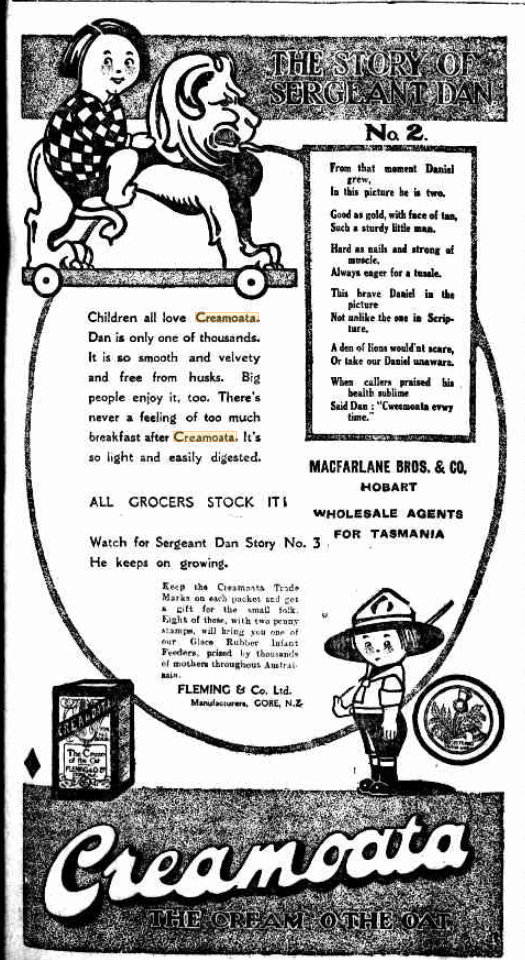
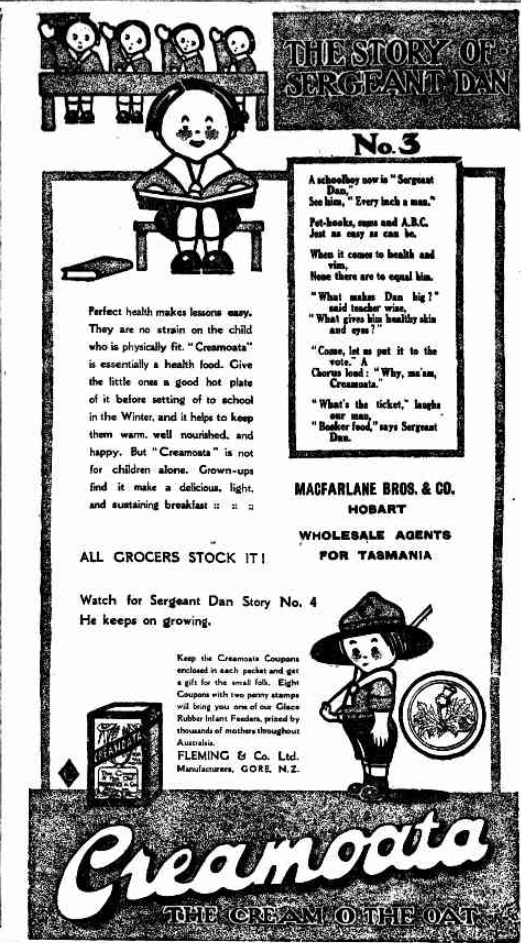
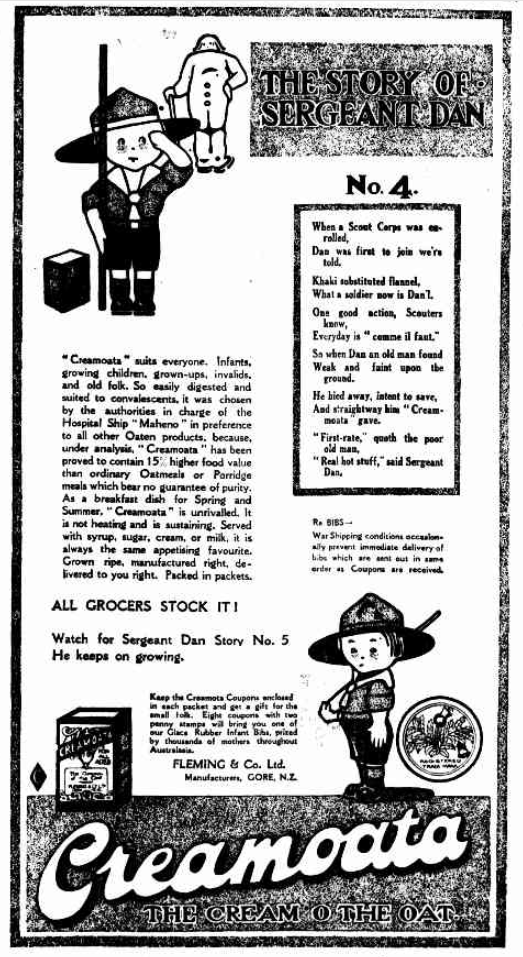
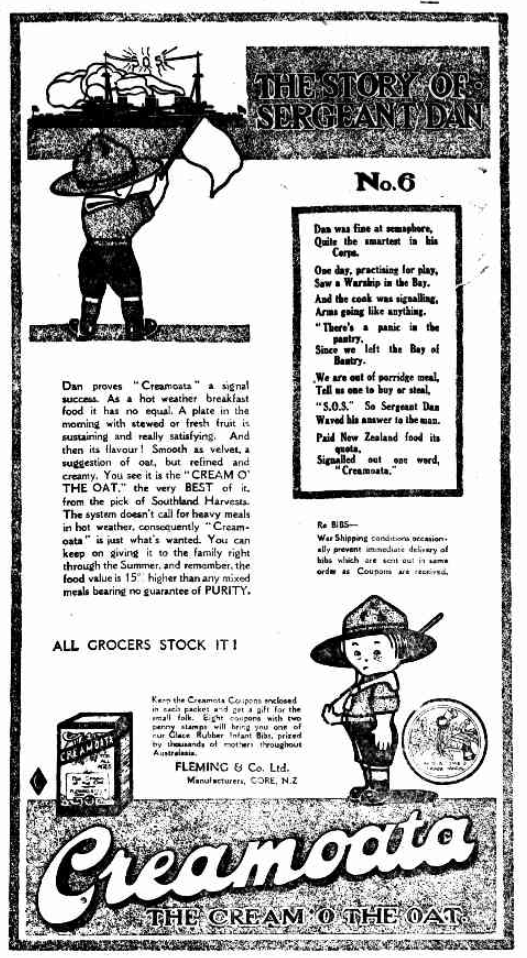
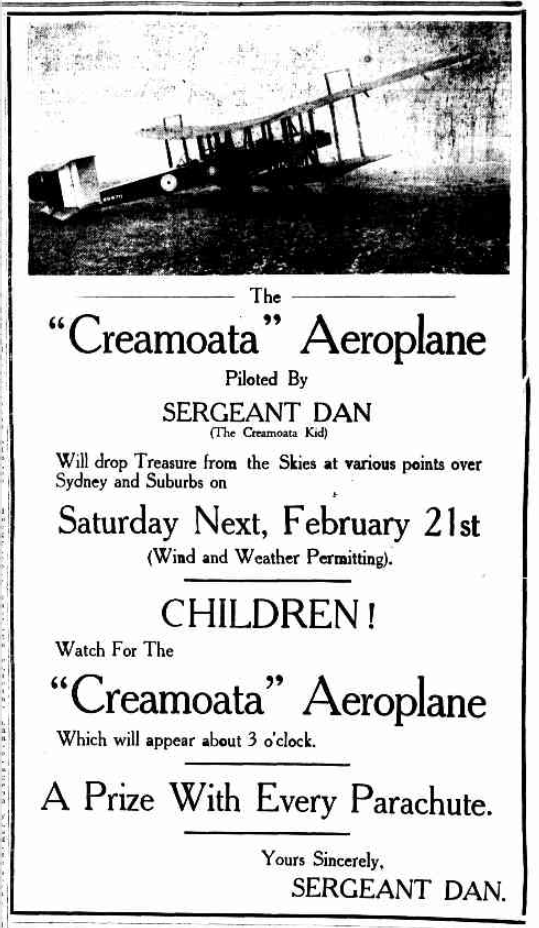
Sergeant Dan, Creamoata and the Maheno.
"Creamoata" suits everyone. Infants, growing children, grown-ups, invalids, and old folk. So easily digested and suited to convalescents, it was chosen by the authorities in charge of the Hospital Ship "Maheno" in preference to all other Oaten products, because, under analysis, "Creamoata " has been proved to contain 15% higher food value than ordinary Oatmeals or Porridge meals which bear no guarantee of purity." (see advertisement 4 below).
Saturday, 2 May 2020
The Hospital Ship Maheno and influenza quarantine - 1919
![]() |
| Empty beds on the hospital ship `Maheno'. Photograph taken by John Dickie during World War I. https://natlib.govt.nz/records/23179980 |
As I write this blog the world is in various states of quarantine for Covid-19. Today's media audiences are wanting political leadership in the face of the disease and simultaneously expressing scepticism about the motives of that leadership.
In 1919 the world faced another pandemic, and the Hospital Ship Maheno was caught up in it. Soldiers who had faced the rigours of WWI now faced the risk of a dangerous strain of influenza.
As I tidied the attached text on Trove, I was aware that I may have passed over this a few months ago, and yet in our own pandemic it seems strangely prescient.
The following appeared in the Albany Advertiser of Wednesday 15 January 1919
MUCH has to be accepted without question in the matter of quarantine. That is admitted. The medical advisers of the Government define what is necessary in the public interest, and the professional officers of the department see that the regulations imposed are carried out. It is not for individuals to reason why, but to submit to the restrictions placed on them with a ready acquiescence and manifest a desire to co-operate with the authorities in every possible way. This also is admitted. But when the necessity arises to make quarantine so general on the coast as it is at the present time, it is surely only due to the intelligence of the people that less mystery should be made, and more consistency should be dis-played by those in charge of the arrangements. Above all, it is essential to the peace of mind of the community that no cause should be given for suspicion of political juggling in the conduct of the business. Albany, as an important port on one of the main ocean trade routes of the world, is equipped with accommodation for quarantine purposes on an extended scale, and is consequently very much interested in what is going on, and the towns-people behind the port are entitled to just as much consideration in the circumstances as those behind Fremantle, Melbourne and Sydney. The fact that they are fewer in numbers does not warrant discrimination against them. That, is where the distrust of political influence comes in. And if there are misgivings locally on this score the authorities are entirely to blame for them. Experience with the unfortunate transport Boonah started this distrust. The Boonah returned to Fremantle with pneumonic influenza on board, and anchored in the open roadstead to land her patients and local contacts at Woodman's Point. She wanted coal to take her on to the Eastern States, but excitement rose to fever heat ashore as to the danger she was to the good people of Fremantle, and no effort was made to take her in the harbour for it. A period of indecision on the part of the authorities followed, and when finally the Returned Soldiers' Association took a hand in the interest of the men remaining on board, the steamer weighed anchor and ran for Albany. Here, without hesitation, she entered the harbour, and overtures were made for shore labor to supply her bunkers. It is obvious that but for the row in Perth and Fremantle the Boonah would have entered the harbour there and sought to coal. That she did not do so, and did here what public opinion prevented elsewhere established for all time the fact that the authorities are willing; to treat this port in a way they do not dare treat a port with a bigger vote behind it. The lumpers at Albany saved the situation by refusing to coal the Boonah unless fully secured against possible contingencies, and the boat coaled herself. The next doubtful visitor was the New Zealand hospital ship Maheno, which, although apparently a clean ship, arrived from the Dominion before the quarantine period had expired. Nevertheless, shore labor was asked to deliver the coal on board, while the trimming was done from within. As in the case of the Boonah, this was said to be a perfectly safe process, but the men declined to proceed because of the inconsistency manifested by the authorities in their changing attitude. Complications similar in character have arisen over the steamers War Armour and Malta, both of which are still in harbour in strict quarantine. Now, in the case of these vessels, there is no certainty that perfect isolation has been secured, and if that is so, why is discrimination of the kind shown? In the first place there are not enough medical men in the town to cope with the work and offer absolute security to the town. The authorities in this regard are displaying especial carelessness, for the least the community can expect is that the very few private medical practitioners in its midst shall be disassociated for the time being with quarantine work. It is all very well for a Government department to say that every precaution is being taken, when merely casual observation proves the contrary, and it is small wonder that public confidence is failing. This, of course, applies to vessels known to be infected. There is no danger in their case of shore labor being implicated. But there is another kind of ship to be considered, and that is the ship apparently clean, but open to suspicion because she is not sufficiently long out from an infected port to be absolutely safe. What is wanted, in such cases, is a better understanding with shore labor, so that the men's services may bc secured and the men's interests protected. The community, as well as the men, would be glad to see an intelligent agreement reached. Much time would be saved if a quarantine battalion of workers were formed, under reasonable guarantee, on a voluntary basis. Such a step has everything to re-commend it, and it is surprising the authorities have not seen fit to so organise the labor of the port. During the nest few weeks many ships within the time limit may be expected, and some such plan is essential to the safe conduct of the business of the port. In any case the people of Albany have no great reason to be satisfied with the measures taken for their protection.
The Bunya proclamation - 1842
One expects stories of colonisation to be stories of exclusion and deprivation, whereby the colonist excludes the original inhabitants of th...
-
'The Courier' (later the Courier Mail) of 8 December 1909, published a timeline of Queensland's history from the time of separ...
-
A recent school excursion to Stradbroke Island under the guidance of the great team at the Jacob’s Well Environmental Education Centre, reve...
-
Two items aboard the Loch Ard were destined for display at the Melbourne International Exhibition in 1880. This Peacock was one of them, I...