Labels

Aboriginal words (2) Advertising (2) Alexander Ritchie (1) Allan Cunningham (1) Antarctica (4) ANZAC (17) Asylums (10) Banjo Paterson (7) Boongaree (1) Brisbane (2) Brisbane History (2) Bunya pine (1) Cambus Wallace (1) Charles Alfred Owen (1) chickens (1) Chinese shepherds (3) Clement Scott (1) colonial Australia (1) convicts (2) Coronial Files (3) Daphne Mayo (1) Dr. Scholes (2) Dungaree March (1) Dunlop Motor Reliability Trial (5) Endurance (3) Ernest Shackleton (3) Flagstaff Hill Maritime Museum (5) Freestone (1) Ghost Gate (1) Glengallan (1) gold (1) Google Arts and Culture (1) Google Earth (1) Google My Maps (1) Goomburra (2) Great Ocean Road (1) Hector Vasyli (1) Index (3) Jacobs Well Environmental Education Centre (1) Karara (2) Lionel Lindsay (2) Loch Ard ship (15) long read (2) Lunacy (8) Ma Ma Creek (1) Maheno (9) Man from Goondiwindi (1) Matthew Flinders (1) Nototherium (1) Place names (2) Platypus (1) poem for recitation (7) poetry (20) puzzles (2) quarantine (1) Queensland (1) Queensland State Archives (6) Rescue (ship) (1) Rev. William Draper (1) S G Mee (2) Samuel K Cowan (2) Scottish Women's Hospital (1) Shackleton (1) shepherds (1) ship wreck (2) Sloop Norfolk (1) Soldier Letters (6) Southern Downs (1) SS Whampoa (1) State Library of Queensland (1) State Library of Victoria (1) Sydney (1) Sydney Morning Herald (1) The Gap (1) The Sydney Herald (1) Thomas White (1) Toowong Cemetery (1) Transcripts of primary sources (4) Trove (72) Warwick (4) Warwick Cenotaph (1) Warwick Daily News (1) Warwick General Cemetery (1) Waterloo Push (1) William Mitchner (1) Woogaroo (11) Writing (1) Yangan (1) Zachariah Sutcliffe (3)

Sunday, 10 May 2020

Coronial file for Georgie, South Sea Islander - Goodna Hospital for the Insane - 1898

The following is a transcript of the Inquest of Death, concerning Georgie, a South Sea Islander, at Woogaroo Asylum who died in 1898. It is based on the Microfilm copy held at the Queensland State Archives Item ID 2734577, all statements were handwritten.

The intent with this post is to make primary sources more readily available, hence there is little comment. However I will comment that this inquest is one of three related to death by tuberculosis in a short space of time.

390/98


"INQUESTS OF DEATH ACT OF 1866.”


CERTIFICATE OF PARTICULARS.-- INQUEST OF DEATH. 

I HEREBY CERTIFY, that on the twenty sixth day of September 1898, I held an Inquest of Death at Woogaroo Asylum in the Police District of Oxley and that the following particulars were then disclosed :-- 

Name of deceased : Georgie S.S.I.

Profession or calling : Labourer

Height, colour of hair, peculiar clothing, and any other means of identity: [Blank]

Where found and when : Woogaroo Asylum 25th September 1898

Date of death : 25th September 1898

Supposed cause of death : Tubercular disease of the bowel.

Persons last seen in company of deceased, and names of suspected persons: [Blank]

Accused : [Blank]

Names, residences, and calling of witnesses:

Dr Jas. K. Nicoll, Woogaroo 

F. Vieth, Attendant, Woogaroo

Suspicious circumstances: [Blank]

[Signed] W. Galdwyn M.

Coroner or Justice.


NOTE.- One Copy of this Certificate to be attached to the Inquest of Death Deposition and forwarded The Honourable the Attorney-General, and a Duplicate to be sent to the Commissioner of Police. See Section 3 of "Inquests of Death Act of 1866" (30 Vic. No. 3). A Copy must also be forwarded, together with the “Certificate of Information,” to the District Registrar of the District within which the Death took place. 


James Robert Nicoll on oath saith :-  I am a medical practitioner registered in Queensland and acting superintendent of the Hospital for the Insane at Goodna. I knew deceased patient Georgie a Pacific Islander. He was admitted to the Hospital on July 20, 1896 in good bodily condition and suffering from Melancholia. He remained dull and despondent and showed no sign of improvement mentally. Last week he was seen to be ill although he did not complain, and he was sent to bed in the Hospital. He sank steadily and died about 5:45 am September 25. Next day day I made an examination of the body and found the cause of death to be Tubercular disease of the Bowel - the pleura and peritoneum being also tuberculosis.


[Signed] Jas R. Nicoll 


Frederick Vieth on oath saith :-  I am an attendant at this Asylum.  I knew the deceased patient Georgie since 17th September last, on that date when I came on night duty I found him in Hospital. When I came on duty on the evening of the 24th Inst. there did not seem to be anything unusual the matter with him, about 5.45 am 25th Inst. I heard some breathing very heavy and on going into the room I found it to be Georgie. He died at 5.50 am 25th September 1898, in my presence. He was visited the evening before his death by Dr Nicoll.


[Signed] F. Vieth


Taken and sworn before me at Goodna this 26 Sept AD 1898.


[Signed] W. Galdwyn Me 


Coronial file for Charlie, an aboriginal - Goodna Hospital for the Insane - 1900

The following is a transcript of the Inquest of Death, concerning Charlie, an aboriginal, at Woogaroo Asylum who died in 1900. It is based on the Microfilm copy held at the Queensland State Archives Item ID 2735482, all statements were handwritten.

The intent with this post is to make primary sources more readily available, hence there is little comment. However I will comment that this inquest is one of three related to death by tuberculosis in a short space of time.


258/00
"INQUESTS OF DEATH ACT OF 1866.”

CERTIFICATE OF PARTICULARS.-- INQUEST OF DEATH. 
I HEREBY CERTIFY, that on the twenty first day of June 1900, I held an Inquest of Death at Woogaroo Asylum in the Police District of Oxley and that the following particulars were then disclosed :-- 
Name of deceased : Charlie (Aboriginal)
Profession or calling : None
Height, colour of hair, peculiar clothing, and any other means of identity: [Blank]
Where found and when : Woogaroo Asylum 21st June 1900
Date of death : 21 June 1900
Supposed cause of death : Tuberculosis of the intestines, Dropsy
Persons last seen in company of deceased, and names of suspected persons: [Blank]
Accused : [Blank]
Names, residences, and calling of witnesses:
Dr K. E. Shaw, Woogaroo Asylum
G. Locke, attendant, Woogaroo
Suspicious circumstances: [Blank]
[Signed] W. Galdwyn M.
Coroner or Justice.

NOTE.- One Copy of this Certificate to be attached to the Inquest of Death Deposition and forwarded The Honourable the Attorney-General, and a Duplicate to be sent to the Commissioner of Police. See Section 3 of "Inquests of Death Act of 1866" (30 Vic. No. 3). A Copy must also be forwarded, together with the “Certificate of Information,” to the District Registrar of the District within which the Death took place. 


Robert English Kane on oath saith :-  I am Assistant Medical Superintendent to the hospital for Insane at Goodna. I knew the deceased Charlie (aboriginal) who was admitted into the Hospital for the Insane at Goodna on the 3rd May 1899 attended him during his illness up to the time of his death which took place on the morning of the 21st June 1900. I immediately viewed his dead body before removal from the Male Hospital Ward No VI. 
He Cause of Death which was ascertained by postmortem examination was Tuberculosis of the intestines followed by Dropsy

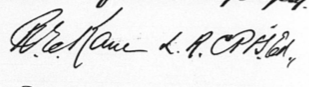
[Signed] R. E. Kane L. R. ??? 


Taken and sworn before me this 21st day of June 1900 at Goodna
[signed] W. Galdwyn Me 

George Lock on oath saith :-  I am an attendant at this Asylum. I knew the deceased patient Charlie since the second of the present month on which date he was received into the Hospital from No. 1 Ward and put to bed. He took his foods fairly well but did not seem to improve. When I came on duty this morning he appeared in a sinking condition. He died in my presence at 8.30 am 21 June 1900.

The body was viewed after death by Dr. Kane.

[Signed] G Locke

Taken and sworn before me this 21st day of June 1900 at Goodna
[Signed] W. Galdwyn Me 
Saturday, 9 May 2020

The Minton Majolica Peacock at MAAS

In September 2019, I visited and photographed the Minton Majolica peacock on display at the Powerhouse Museum in Sydney.  My interest in this bird stemmed from the survival of an identical piece now labelled as the "Loch Ard Peacock". I have written previously about this artefact in my investigations into the wrecking of the Loch Ard in 1878.

The MAAS peacock dates to 1875 and is on display as part of the Icons: From the MAAS Collection exhibit (https://ma.as/206174).

Strangely the MAAS display indicates that one of these peacocks had been on display at the 1880-1881 Melbourne Exhibition.  That exhibition was the destination for the Loch Ard Peacock, and but I could not find any record of it making it there.

The main purpose of this post is to provide some photos of the Peacock 'conservatory ornament', a task that is not as easy at Flagstaff Hill as the Flagstaff artefact is behind glass.

.
The Milton Peacock overlooking a 1928 Bugatti at MAAS.

.
Tail view

.
Tail detail
.
Vine view

.
Head detail

.
Blackberry leaves

.
Fungi

.
Claw

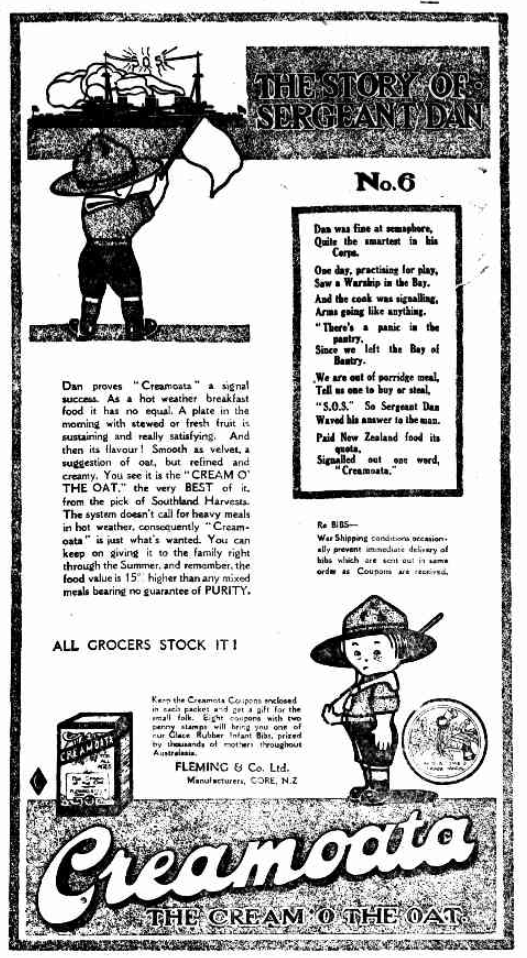
Sergeant Dan, Creamoata and the Maheno.

In this post I will allow you to ponder the charm of a cartoon boy scout and a set of rhyming couplets being used to advertise breakfast cereal.

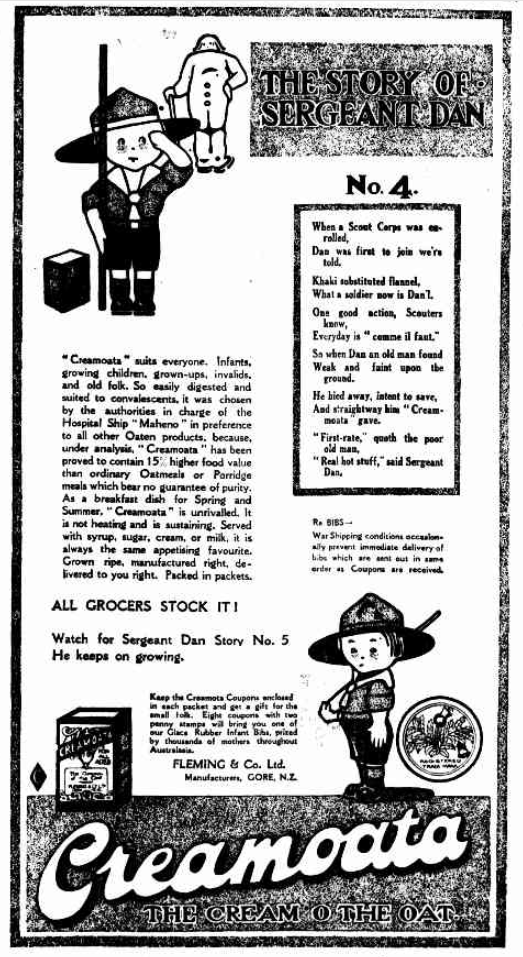
Readers who have read the "Letters from the Maheno" posts in this blog (use the 'Maheno' keyword in the label cloud if you are interested) will know that those who travelled on the Hospital Ship Maheno spoke very highly of her.  While the Maheno was a New Zealand ship her fame certainly travelled over the Tasman to Australia, as all of the letters I have published to date have been from the Australian Press. She was admired also by an advertising agency for the fast porridge, 'Creamoata', a product made at Gore in the South Island of New Zealand.  They used the Maheno's name and reputation to promote the product 

"Creamoata" suits everyone. Infants, growing children, grown-ups, invalids, and old folk. So easily digested and suited to convalescents, it was chosen by the authorities in charge of the Hospital Ship "Maheno" in preference to all other Oaten products, because, under analysis, "Creamoata " has been proved to contain 15% higher food value than ordinary Oatmeals or Porridge meals which bear no guarantee of purity." (see advertisement 4 below).

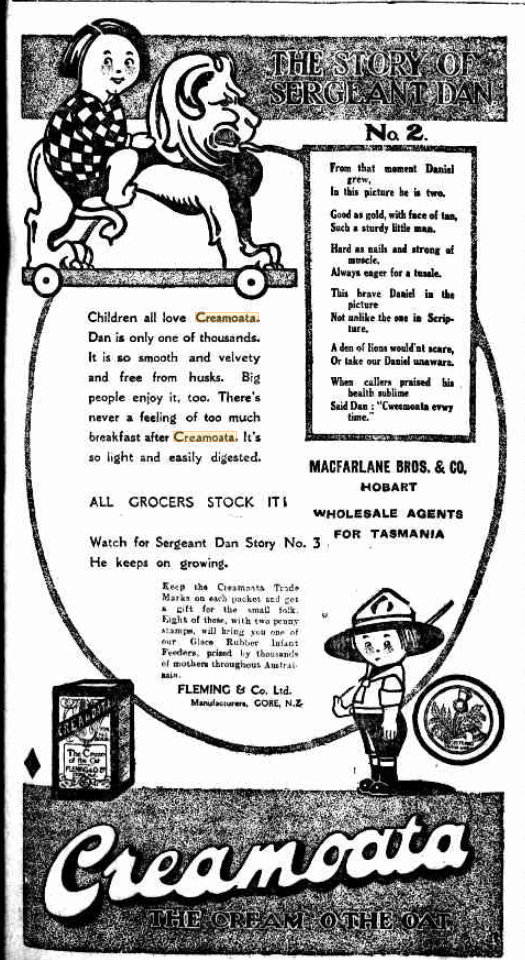
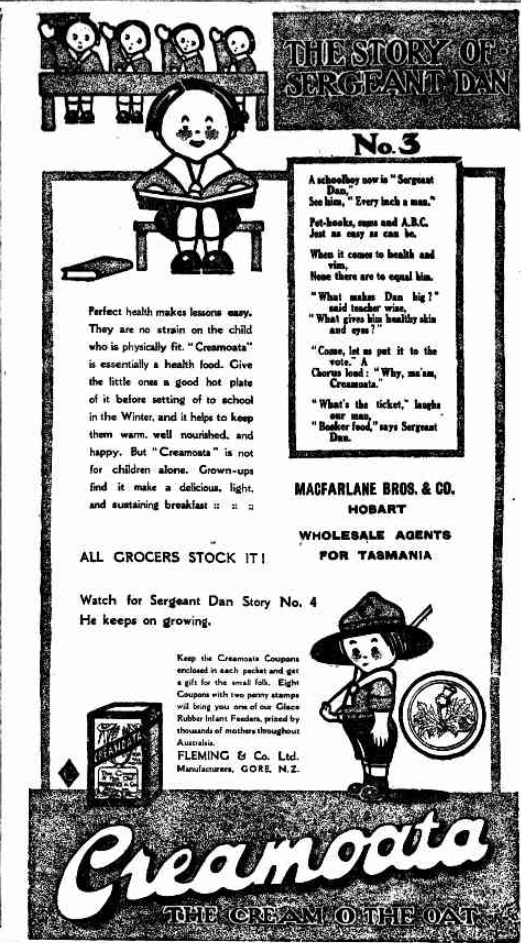
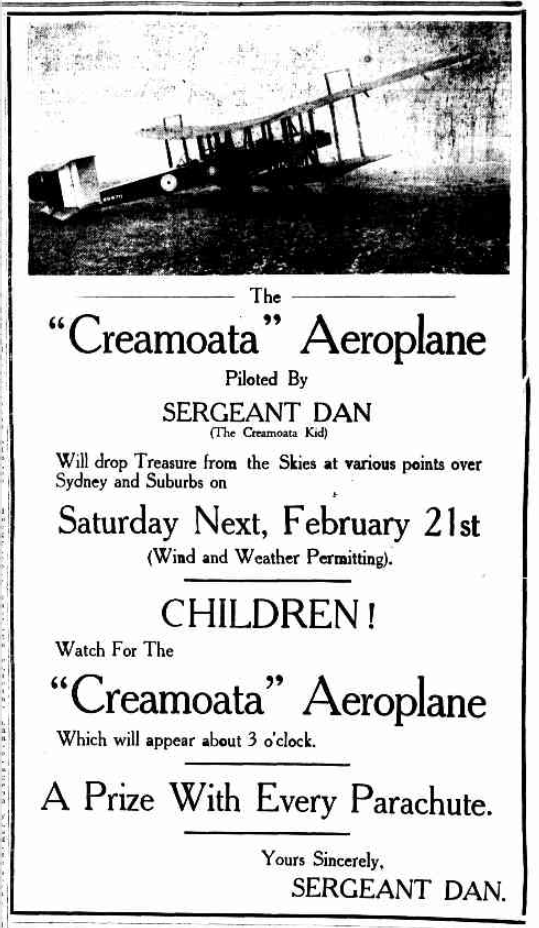
But being the collector that I am I could not stop at one advertisement, I needed to collect all six advertisements in the series. The advertisements trace the life of a fictional Sargeant Dan and all of them presented here are from the The Mercury (Hobart). The advertising has two cycles, starting first in 1916, and then a second run of the ads in sequence starting early in 1917.  After the final in the series, No. 6, which coincides with the end of WWI, advertising returns to something with a less clear narrative arc.  But in 1920 it is clear that 'Cremoata' wants to break into the Australian mainland market and Sergeant Dan returns, flying a plane over Sydney to drop treasure by parachute to would-be customers. These 'gifts' were silver spoons on a parachute, which segued nicely into the next part of the advertising cycle, which had a strong focus on spoons.

Later advertising for the product will see a tilt to the female market, especially the Girl Guides. But for now here are seven advertisements for 'Creamolata'.


In this picture, dears, behold, 
Sergeant Dan at nine months old.
Far from being his parents' joy,
A grizzling, grouchy little boy
Never chuckled, never goo-ed, 
Made a lip at bottle food.
Till his Ma in desperation
Said : " No more of hesitation.
He'll only have in future what'll
Make him thrive. No more of bottle.
For milk I care not one iota, 
I'll put the darling on "Creamoata."


From that moment Daniel grew,
In this picture he is two.
Good as gold, with face of tan, 
Such a sturdy little man.
Hard as nails and strong of muscle,
Always eager for a tussle.
This brave Daniel in the picture
Not unlike the one in Scripture.
A den of lions wouldn't scare, 
Or take our Daniel unaware.
When callers praised his health sublime
Said Dan : "Cweemoata evwy time."


A schoolboy now is "Sargeant Dan,"
See him, "Every inch a man."
Pot-hooks, sums and A.B.C.
Just as easy as can be.
When it comes to health and vim,
None there are to equal him.
"What makes Dan big?" said teacher wise,
"What gives him healthy skin and eyes?"
" Come, let us put it to the vote." A
Chorus loud : ""Why, ma'am, Creamoata."
"What's the ticket," laughs our man,
"Bosker food," says Sergeant Dan.


When a Scout Corps was enrolled,
Dan was first to join we're told.
Khaki substituted flannel,
What a soldier now is Dan'l
One good action, Scouters know,
Everyday is " comme il faut" 
So when Dan an old man found 
Weak and faint upon the ground.
He hied away, intent to save,
And straightway him "Creamoata" gave.
"First-rate," quoth the poor old man,
"Real hot stuff," said Sergeant Dan.


In his scouting Dan put zest, 
Always did his very best.
Here is pictured quite complete,
His most famous Scouting feat.
One day hungry was his Corps,
Lunch done, still they hungered more.
So Dan said, "I'll commandeer,
I'll get something, never fear."
When there's bread and jam and bloater,
There is sure to be " Creamoata."
And he found it, dauntless man,
"All is fair in War," said Dan.


Dan was fine at semaphore, 
Quite the smartest in his Corps.
One day, practising for play
Saw a Warship in the Bay.
And the cook was signalling, 
Arms going like anything.
"There's a panic in the pantry,
Since we left the Bay of Bantry.
We are out of porridge meal, 
Tell us one to buy or steal,
"S.O.S.'' So Sergeant Dan 
Waved his answer to the man. 
Paid New Zealand food its quota,
Signalled out one word, "Creamoata."


The Aeroplane Advertisement -- Advertising (1920, February 19). The Sun (Sydney, NSW : 1910 - 1954), p. 5. , it also appeared in the same paper the following day.


Saturday, 2 May 2020

The Hospital Ship Maheno and influenza quarantine - 1919

Empty beds on the hospital ship `Maheno'. Photograph taken by John Dickie during World War I. https://natlib.govt.nz/records/23179980

As I write this blog the world is in various states of quarantine for Covid-19.  Today's media audiences are wanting political leadership in the face of the disease and simultaneously expressing scepticism about the motives of that leadership.

In 1919 the world faced another pandemic, and the Hospital Ship Maheno was caught up in it.  Soldiers who had faced the rigours of WWI now faced the risk of a dangerous strain of influenza.

As I tidied the attached text on Trove, I was aware that I may have passed over this a few months ago, and yet in our own pandemic it seems strangely prescient.

The following appeared in the Albany Advertiser of Wednesday 15 January 1919

MUCH has to be accepted without question in the matter of quarantine. That is admitted. The medical advisers of the Government define what is necessary in the public interest, and the professional officers of the department see that the regulations imposed are carried out. It is not for individuals to reason why, but to submit to the restrictions placed on them with a ready acquiescence and manifest a desire to co-operate with the authorities in every possible way. This also is admitted. But when the necessity arises to make quarantine so general on the coast as it is at the present time, it is surely only due to the intelligence of the people that less mystery should be made, and more consistency should be dis-played by those in charge of the arrangements. Above all, it is essential to the peace of mind of the community that no cause should be given for suspicion of political juggling in the conduct of the business. Albany, as an important port on one of the main ocean trade routes of the world, is equipped with accommodation for quarantine purposes on an extended scale, and is consequently very much interested in what is going on, and the towns-people behind the port are entitled to just as much consideration in the circumstances as those behind Fremantle, Melbourne and Sydney. The fact that they are fewer in numbers does not warrant discrimination against them. That, is where the distrust of political influence comes in. And if there are misgivings locally on this score the authorities are entirely to blame for them. Experience with the unfortunate transport Boonah started this distrust. The Boonah returned to Fremantle with pneumonic influenza on board, and anchored in the open roadstead to land her patients and local contacts at Woodman's Point. She wanted coal to take her on to the Eastern States, but excitement rose to fever heat ashore as to the danger she was to the good people of Fremantle, and no effort was made to take her in the harbour for it. A period of indecision on the part of the authorities followed, and when finally the Returned Soldiers' Association took a hand in the interest of the men remaining on board, the steamer weighed anchor and ran for Albany. Here, without hesitation, she entered the harbour, and overtures were made for shore labor to supply her bunkers. It is obvious that but for the row in Perth and Fremantle the Boonah would have entered the harbour there and sought to coal. That she did not do so, and did here what public opinion prevented elsewhere established for all time the fact that the authorities are willing; to treat this port in a way they do not dare treat a port with a bigger vote behind it. The lumpers at Albany saved the situation by refusing to coal the Boonah unless fully secured against possible contingencies, and the boat coaled herself. The next doubtful visitor was the New Zealand hospital ship Maheno, which, although apparently a clean ship, arrived from the Dominion before the quarantine period had expired. Nevertheless, shore labor was asked to deliver the coal on board, while the trimming was done from within. As in the case of the Boonah, this was said to be a perfectly safe process, but the men declined to proceed because of the inconsistency manifested by the authorities in their changing attitude. Complications similar in character have arisen over the steamers War Armour and Malta, both of which are still in harbour in strict quarantine. Now, in the case of these vessels, there is no certainty that perfect isolation has been secured, and if that is so, why is discrimination of the kind shown? In the first place there are not enough medical men in the town to cope with the work and offer absolute security to the town. The authorities in this regard are displaying especial carelessness, for the least the community can expect is that the very few private medical practitioners in its midst shall be disassociated for the time being with quarantine work. It is all very well for a Government department to say that every precaution is being taken, when merely casual observation proves the contrary, and it is small wonder that public confidence is failing. This, of course, applies to vessels known to be infected. There is no danger in their case of shore labor being implicated. But there is another kind of ship to be considered, and that is the ship apparently clean, but open to suspicion because she is not sufficiently long out from an infected port to be absolutely safe. What is wanted, in such cases, is a better understanding with shore labor, so that the men's services may bc secured and the men's interests protected. The community, as well as the men, would be glad to see an intelligent agreement reached. Much time would be saved if a quarantine battalion of workers were formed, under reasonable guarantee, on a voluntary basis. Such a step has everything to re-commend it, and it is surprising the authorities have not seen fit to so organise the labor of the port. During the nest few weeks many ships within the time limit may be expected, and some such plan is essential to the safe conduct of the business of the port. In any case the people of Albany have no great reason to be satisfied with the measures taken for their protection.

Saturday, 25 April 2020

Moored to a sea mine

A WWI German sea mine being launched from the back of a ship.
http://nla.gov.au/nla.news-article166255579

Another story associated with the travels of the New Zealand Hospital Ship Maheno. As relayed in the Sydney Morning Herald Friday 12 September 1919.

MOORED TO A MINE.
TWO MEN IN A BOAT.
EXPERIENCE IN THE ENGLISH CHANNEL. 
Captain Cain, of the Union Steamship Company's new steamer Waitemata, which arrived from Calcutta, via ports, a few days ago, has had the thrilling experience of being "moored to a German mine." 
It occurred during the war, and the act was voluntary on the captain's part. 
"An officer, who was an eye-witness of the exploit, related the facts in Sydney yesterday; but Captain Cain himself, apart from admitting that "such an incident" took place, preferred to say little or nothing regarding it.  
During the war Captain Cain had charge of a patrol vessel in the Mediterranean, and eventually left his vessel in Egypt. His work being completed, he desired to return to England. He bad not been demobilised, and the Government would have arranged for his passage home, but, as the Union Company's steamer Maheno was then in port, be decided to try to return to England in her. 
He interviewed Captain Neville, of the Maheno, and as the latter was short of officers it was agreed that Captain Cain, and a fellow-officer who had been on active service with him, should be engaged for the run to England. 
Everything went well until the Maheno approached the entrance to the English Channel, when a floating mine was sighted. Captain Neville had nothing with which to explode the mine, and was unable immediately to get into wireless communication with the naval authorities. As the mine was right in the track of shipping, it constituted a serious danger. Even if the Maheno left it until her arrival in port the chances that some vessel I would strike the mine before it could be again located and destroyed were by no means small. 
Captain Cain accordingly came forward, and asked for the loan of one of the ship's boats, a length of rope, and some flare lights. These were granted, and Captain Cain and his friend left the steamer in the boat and pulled over to the mine. After making fast to the mine and paying out a fair length of rope, the two officers sat down to await the arrival of assistance. 
The Maheno left the men in the boat moored to the mine, and proceeded on her way to Southampton, where she reported the incident to the naval authorities. The exact locality of the mine was given, and a "P" boat was despatched at full speed to the scene. 
For between seven and eight hours Captain Cain and his friend remained with their boat bobbing about on the surface of the sea, and still tied to the instrument of destruction. Several steamers were sighted, but no signals were made to any of them, as it was feared that they might not he able to avoid the mine if they were induced to approach the boat. 
As It grew dark the flare lights were got ready in case of the approach of a steamer, but some time after darkness had closed in a searchlight commenced swooping the water in the vicinity of the boat. This was from the "P" boat which had been sent out at the request of Captain Neville. 
Before long the "P" boat arrived, picked up the two men, and, after exploding the mine, was soon racing back to port with Captain Cain and his friend on board.

Letters from the hospital ship 'Maheno', No 6.

Detail of the Maheno show the doors in the side.
The utility of these doors is often mentioned in articles about the ship.
https://nzhistory.govt.nz/media/photo/discharging-patients-alexandria


A small series, of unknown length, highlighting letters from the hospital ship, 'Maheno'.
Part of my ANZAC Commemoration in the year 2020.

Assumed Identity

Name: Eric Edward McGrath
Service No: 2518
Enlisted: 13 Dec 1816
Unit: 44th Australian Infantry Battalion
Source: Australian War Memorial

Letter as it appears in the Delegate Argus (NSW : 1906 - 1943), Thursday 7 December 1916, page 2

"Fritz Got Me at Last" 
A report got around some time ago that Private E. McGrath, one time teacher at Woodglen School, had gone under at the front. Such is not the case. He has been wounded, but last word to local friends said he was doing well. Those who know 'Mac' will read the following letter, which comes from him, with interest:— 
"Fritz has got me at last. I have had a long run and many a good mate has been knocked over alongside me, and there are not too many left of the crowd who crossed with me on the "Medic." We were taken out of the line we were holding near Armentieres about the end of June and formed into a mobile division. That meant that we marched where other troops were carried in trains. Well, we marched from Armentieres to Albert, taking about three weeks, sleeping in ruined houses and straw stacks, and subsisting upon very scanty rations. Luckily I was in fine condition, and stood the march well. On arrival at Albert — which is in ruins — we left everything behind with our packs, not even taking a towel or soap— only ammunition and food. We took over the trenches in front of Pozieres from the British. They had made several attempts to take the place, but had failed. Their dead were lying all over the place. There were four of them built into the side of the trench where I was, with arms and legs sticking out, and the shell holes were full of them. When the smell got too high we had to get out at night and do the grave digging act. There were plenty of dead square heads around, too. I got a dose of some kind of gas going in, and was pretty sick. The worst want was water. It had to be carried a couple of miles, and each day a few of the carriers were killed by German shells, so we did not waste any of it in washing. After four days, during which we lost a good few men, we attacked at midnight on July 22nd. I was in an advance guard of 20 men to take part of the first line of trenches and dig them out in case our attacks were driven off. We sneaked out with fixed bayonets before midnight, and crept from shell-hole to shell-hole across "No-Man's Land." We laid down about half-way across, and suddenly 200 of our guns opened on the first line and rained shells on it for 20 minutes. Then they shift ed into the next line, and we went for the first. The German guns began to give us a warm reception. I got to the parapet, but a shell explosion upended me, and in getting up some shrapnel smashed my right foot. I shot one German swine though before I collapsed. When I came to I crawled into a shell-hole and dug in as far as I could and said my prayers. It was more like hell than anything you could imagine. Nothing to be seen but great clouds of smoke and the flash of shells, while the shrapnel simply rained down. I did not think it possible for anyone to live there, but our boys came through it in wave after wave, although they fell in hundreds. The wounded were shrieking and swearing, and those of us who could crawl were trying to tie up our wounds and those of our mates. About daylight it slackened, and I started to crawl back to our trenches. Of course I got lost and mixed up in the barbed wire, but after crawling a couple of miles I got into a trench, and was tied up by some stretcher bearers, who gave me a shovel as a crutch and started me back. I got a good way before I went under, and then an engineer officer carried me on his back to a dressing station. From there I went by stretcher, ambulance and train to Le Treporte, on the coast of Normandy. I put in nearly a fortnight here, and was operated on, and had the shrapnel cut out of my foot. They had designs on the foot, but I bluffed them off. Then to Havre, and across to Southampton on the N.Z. hospital ship Maheno. I first went to Fawcett Road Hospital, Southsea, for a week, and then out here. Had another operation the day before yesterday, and have another incision as a result. The nurses and doctors are very kind, but I am feeling only middling. I can't eat since the gas. We have concerts twice a week, and anyone who can go out, especially the Australians, have a good time. Southsea is a part of Portsmouth, and is a great holiday resort."

The Bunya proclamation - 1842

One expects stories of colonisation to be stories of exclusion and deprivation, whereby the colonist excludes the original inhabitants of th...